✉️ [email protected] | 📞 +971-4-2675252


Introduction
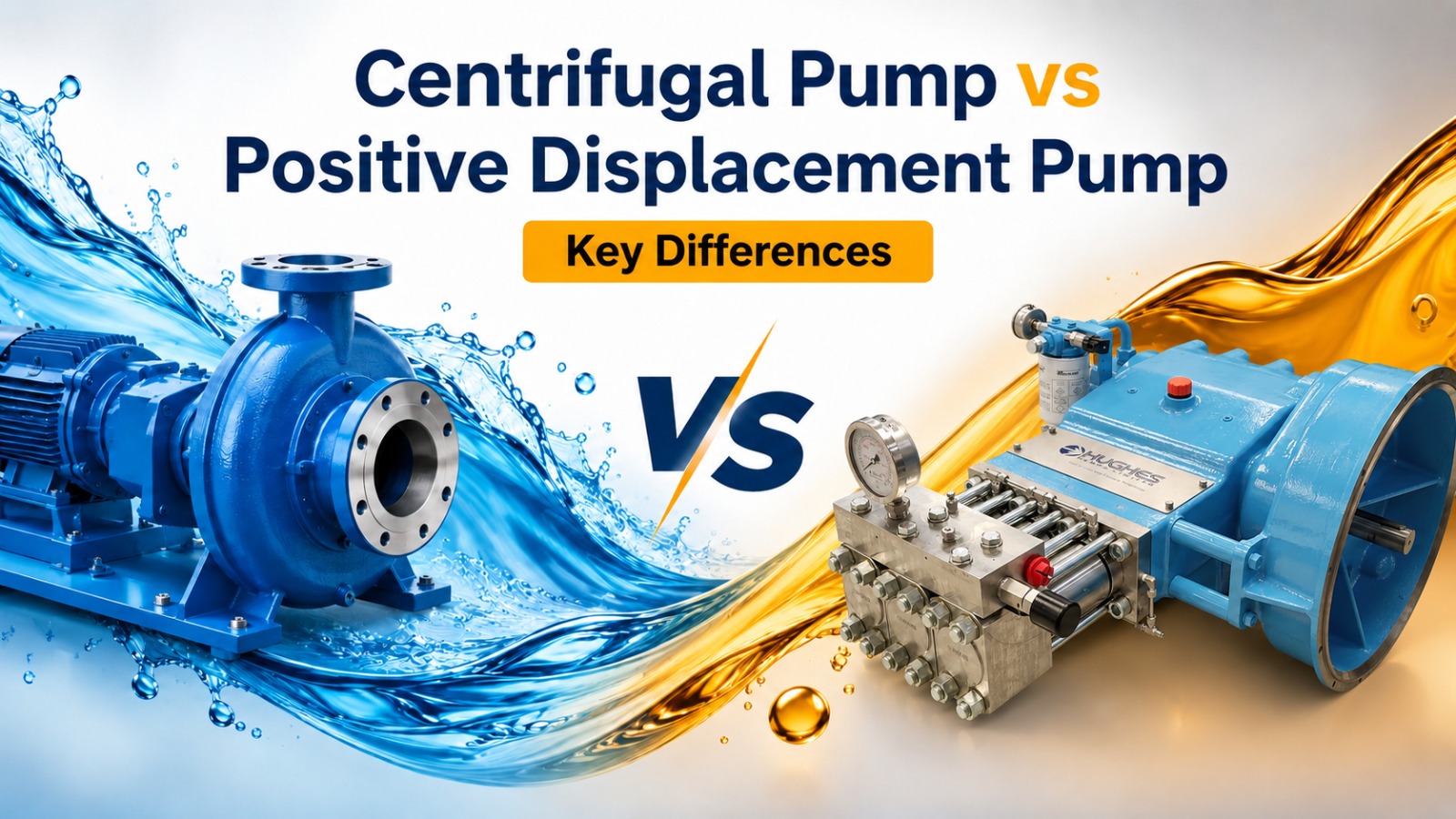
Choosing between a centrifugal vs positive displacement pump is an important step in selecting the right pumping system. Although pressure and flow rate are important, they are not the only factors to consider. In addition, fluid type, viscosity, operating conditions, and the application also play a key role.
Why Choosing the Right Pump Matters
Centrifugal pumps and positive displacement pumps work in different ways and are designed for different jobs. For example, centrifugal pumps are best for moving large amounts of low-viscosity liquids, whereas positive displacement pumps are better for thick fluids, accurate flow control, and high-pressure applications.
Key Takeaways
Before comparing both pump types in detail, here are the most important points to remember:
- Centrifugal pumps are ideal for high-flow applications involving low-viscosity liquids.
- On the other hand, positive displacement pumps deliver a fixed volume of liquid, making them suitable for viscous fluids and precise flow control.
- Moreover, pump selection should consider flow rate, pressure, fluid characteristics, operating environment, and long-term operating costs.
- As a result, choosing the correct pumping solution improves efficiency, reliability, and equipment lifespan while reducing maintenance expenses.
- Finally, working with experienced pump specialists helps ensure the selected system meets both operational and project requirements.
What Is a Centrifugal Pump and How Does It Work?
A centrifugal pump is one of the most widely used industrial pumps. In fact, its simple design, reliable operation, and ability to move large amounts of liquid make it a popular choice for many industries. The pump changes mechanical energy into hydraulic energy by using a rotating impeller. Specifically, the impeller creates fluid velocity, which the pump then converts into pressure.
As the impeller spins, liquid enters through the suction inlet and moves toward the centre of the impeller. Next, the spinning impeller pushes the liquid outward by centrifugal force and into the pump casing. After that, the casing converts the liquid’s velocity into pressure and sends it through the discharge outlet.
As a result, this process allows a centrifugal pump to move large amounts of liquid in a smooth and steady way. Therefore, centrifugal pumps are an excellent choice for applications that require continuous operation.
Furthermore, centrifugal pumps are used in many industries because of their versatility. For instance, these include water treatment, marine operations, power generation, construction, manufacturing, and the Oil & Gas industry.
At Al Khamis Equipment’s LLC, we design and assemble customised multistage centrifugal pump packages for demanding industrial applications. In particular, we supply these systems for pipeline flushing, hydrostatic testing, pipeline commissioning, industrial cleaning, and marine applications where reliable pump performance is essential.
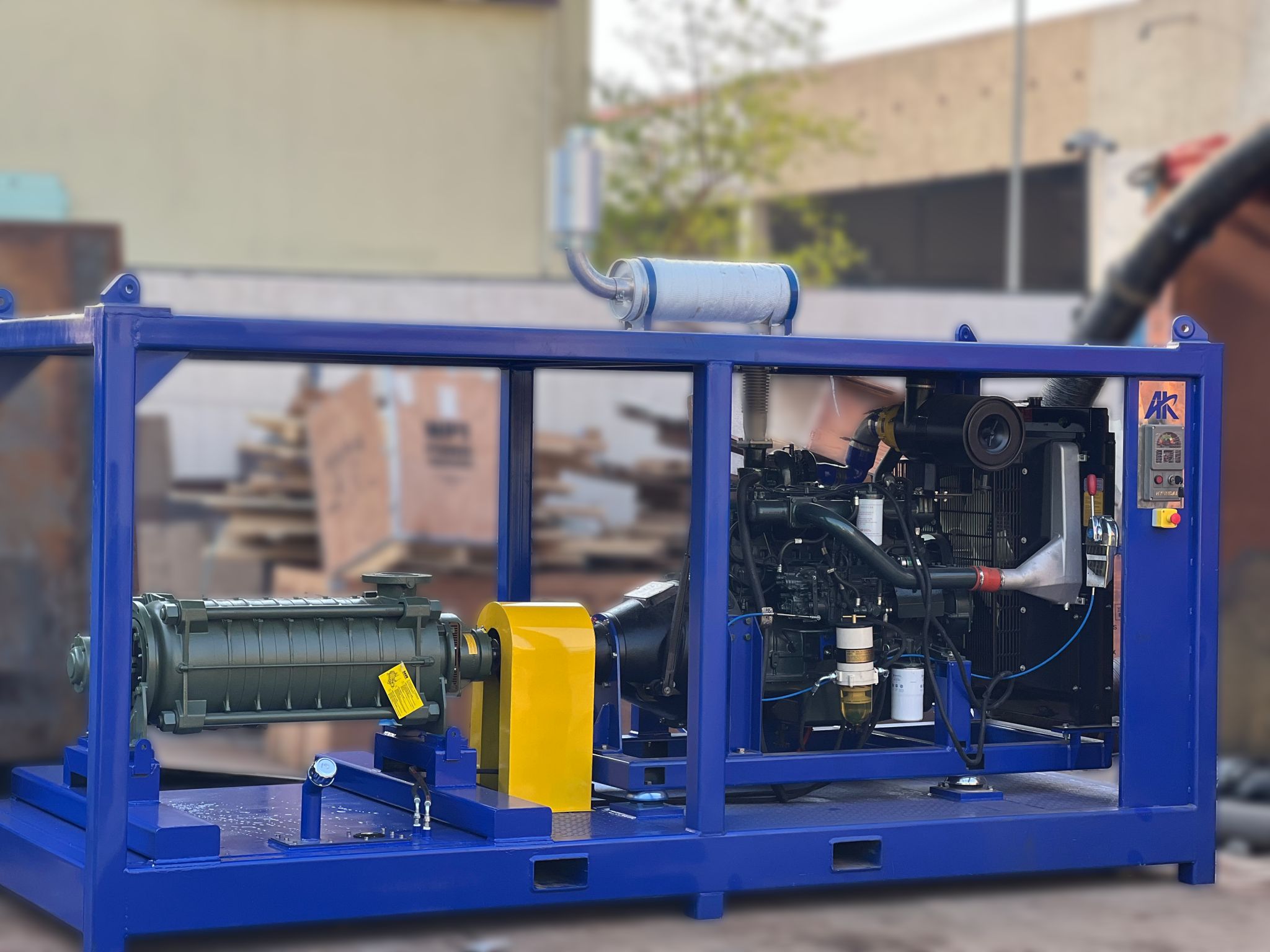
Centrifugal pump unit for industrial applicationsUnderstanding the operating principle of a centrifugal pump makes it easier to determine when this technology is the right choice.
The pumping process follows four simple steps:
1. Liquid Enters the Pump
Liquid enters the pump through the suction inlet and moves toward the centre of the rotating impeller.
2. The Impeller Speeds Up the Liquid
As the impeller spins, centrifugal force pushes the liquid outward at high speed through the impeller vanes.
3. Speed Changes into Pressure
The pump casing slowly reduces the liquid’s speed and increases its pressure. This helps the pump transfer energy to the liquid.
4. Pressurised Liquid Leaves the Pump
Finally, the pressurised liquid leaves through the discharge outlet and enters the piping system. It then moves to the required process or application.
This continuous flow allows centrifugal pumps to run efficiently for long periods. Therefore, they are a good choice for applications that need high flow rates and steady performance.
However, fluid viscosity affects pump performance. For this reason, centrifugal pumps usually work best with clean or low-viscosity liquids such as water.
Common Applications of Centrifugal Pumps
Thanks to their efficiency and versatility, centrifugal pumps are used across a broad range of industries.
Typical applications include:
- Pipeline flushing
- Pipeline commissioning
- Hydrostatic testing
- Water transfer systems
- Industrial cleaning
- Marine pumping systems
- Cooling water circulation
- Irrigation systems
- Fire protection systems
- Water treatment facilities
- Manufacturing processes
- Construction projects
- General industrial fluid transfer
Multistage centrifugal pumps are particularly suitable for applications requiring both high flow rates and elevated discharge pressures, making them an excellent choice for many industrial projects.
Advantages of Centrifugal Pumps
Centrifugal pumps are one of the most popular pump types because they offer good performance, reliable operation, and efficient running.
1. High Flow Capacity
Centrifugal pumps can move large amounts of liquid continuously. Therefore, they are a good choice for industrial systems that need a steady flow.
2. Efficient Continuous Operation
Centrifugal pumps can run for long periods when they are correctly selected and used. They provide stable performance during continuous operation.
3. Simple Mechanical Design
Centrifugal pumps have fewer moving parts than many other pump types. As a result, they are easier to install, check, and maintain. Their simple design also helps improve reliability.
4. Lower Maintenance Needs
Fewer moving parts can reduce wear and make regular maintenance easier. This can help reduce downtime and maintenance costs over the pump’s working life.
5. Cost-Effective Solution
For many applications that use clean liquids, centrifugal pumps can be a cost-effective choice. They offer reasonable purchase costs and efficient operation.
6. Compact Design
Many modern centrifugal pump packages provide high performance while taking up less space. Therefore, they are suitable for facilities where installation space is limited.
7. Good Energy Efficiency
When used with low-viscosity liquids and under the right operating conditions, centrifugal pumps can operate efficiently and use less energy.
When Should You Choose a Centrifugal Pump?
A centrifugal pumping system is often the preferred choice when your application requires:
- High flow rates
- Continuous operation
- Low-viscosity liquids
- Reliable long-term performance
- Lower maintenance requirements
- Cost-effective fluid transfer
- Stable operation under varying flow conditions
Industries such as marine, municipal water, manufacturing, construction, pipeline services, and energy production continue to rely on centrifugal pumps because of their proven performance and operational flexibility.
What Is a Positive Displacement Pump and How Does It Work?
Unlike a centrifugal pump, a positive displacement pump moves a fixed amount of liquid during each cycle. Instead of using centrifugal force to move the liquid, it traps a set amount of fluid inside a chamber. It then pushes the fluid from the suction side to the discharge side.
Because each rotation or stroke moves almost the same amount of liquid, the flow rate stays steady even when system pressure changes. Therefore, positive displacement pumps are a good choice for applications that need accurate flow, precise dosing, or the transfer of thick and highly viscous fluids.
These pumps are widely used in industries where a steady flow is more important than a very high flow rate. They can also handle difficult fluids well. For this reason, they are often used with chemicals, oils, polymers, and other thick liquids.
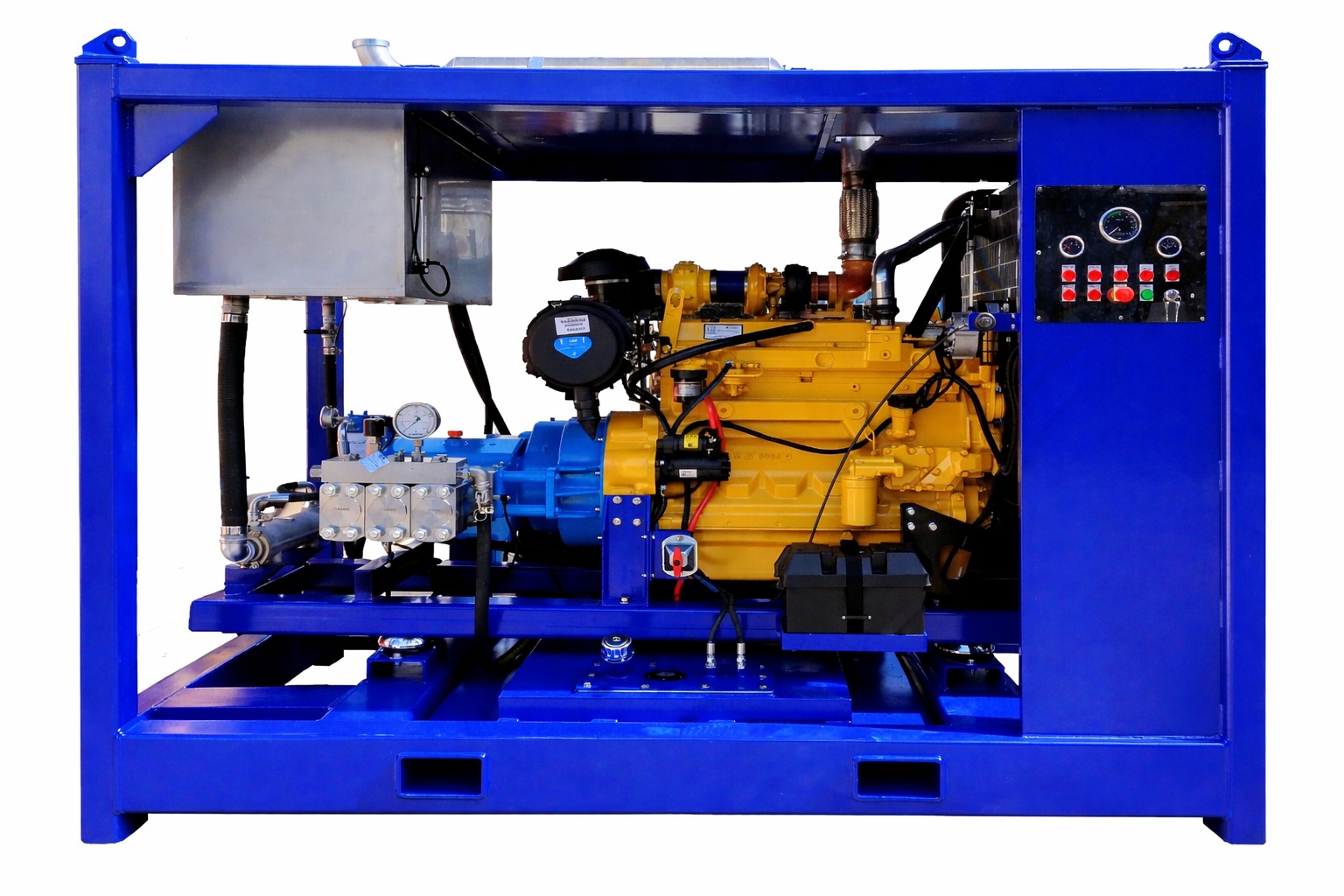
Customised positive displacement pump package by Al Khamis Equipment's LLCAlthough several designs are available, all positive displacement pumps operate using the same fundamental principle.
The pumping cycle has four simple steps:
1. Liquid Enters the Pump
Liquid enters the pump chamber through the suction inlet. At the same time, the pump creates space inside the chamber to take in the liquid.
2. The Pump Traps a Fixed Amount
The pump traps a set amount of liquid inside the chamber. It may use gears, pistons, plungers, screws, diaphragms, or other moving parts to do this.
3. The Liquid Moves Through the Pump
The internal parts keep moving and carry the trapped liquid toward the discharge side.
4. The Pump Pushes the Liquid into the System
The pump pushes the liquid into the discharge pipe at a nearly steady flow rate. This flow stays fairly steady even when the pressure on the discharge side changes.
Unlike centrifugal pumps, positive displacement pumps can keep building pressure if the liquid cannot flow freely. Therefore, pressure relief valves are often used to protect the pump and piping system from too much pressure.
Types of Positive Displacement Pumps
Positive displacement pumps are available in several designs, each developed to suit different operating conditions and fluid characteristics.
Common types include:
- Gear Pumps
- Screw Pumps
- Piston Pumps
- Plunger Pumps
- Diaphragm Pumps
- Rotary Lobe Pumps
- Progressive Cavity Pumps
- Peristaltic Pumps
- Vane Pumps
Each design offers unique advantages depending on factors such as pressure requirements, fluid viscosity, solids content, and the level of flow accuracy required.
Common Applications of Positive Displacement Pumps
Positive displacement pumps are commonly selected for applications where maintaining a constant flow rate is critical or where the liquid is too viscous for a centrifugal pump to handle efficiently.
Typical applications include:
- Chemical dosing
- Fuel transfer
- Lubrication systems
- Hydraulic systems
- Food and beverage processing
- Pharmaceutical manufacturing
- Paint and coating transfer
- Polymer processing
- Heavy oil transfer
- Bitumen handling
- Resin pumping
- High-pressure cleaning systems
- Chemical injection
- Industrial process applications
Their ability to deliver accurate and repeatable flow makes them particularly valuable in industries where product consistency and process control are essential.
Advantages of Positive Displacement Pumps
Positive displacement pumps offer several benefits that make them a good choice for many special industrial applications.
1. Steady Flow Rate
One of the main benefits of these pumps is their ability to deliver almost the same flow even when system pressure changes. Therefore, they work well in systems that need steady and accurate flow.
2.Excellent Performance with High-Viscosity Fluids
Unlike centrifugal pumps, positive displacement pumps efficiently handle thick liquids without significant loss of performance.
Examples include:
- Heavy fuel oil
- Lubricating oil
- Syrups
- Molasses
- Polymers
- Bitumen
- Adhesives
- Paints
- Chemicals
3. High Pressure Capability
These pumps can produce very high discharge pressure. As a result, they are suitable for hydraulic systems, chemical injection, fuel transfer, and other high-pressure applications.
4. Accurate Metering
Many positive displacement pumps can deliver a very accurate amount of liquid during each cycle. Therefore, they are a good choice for chemical dosing and other applications that need controlled flow.
5. Self-Priming Operation
Many positive displacement pumps can prime themselves. This means they can start pumping without a long or complex priming process.
6. Suitable for Sensitive Fluids
Some positive displacement pumps move liquid gently. As a result, they can handle fluids that may be damaged by strong mixing or high shear forces.
Centrifugal vs Positive Displacement Pump: Key Differences
Although both pump technologies are designed to move liquids efficiently, their operating principles, performance characteristics, and ideal applications differ considerably.
Understanding the differences between a centrifugal vs positive displacement pump helps engineers select the right technology for each application.
| Feature | Centrifugal Pump | Positive Displacement Pump |
|---|---|---|
| Operating Principle | Uses centrifugal force generated by a rotating impeller | Traps and moves a fixed volume of liquid during each cycle |
| Flow Rate | High flow capacity | Constant flow regardless of pressure changes |
| Pressure Capability | Moderate to high (especially multistage designs) | Very high discharge pressure |
| Best Fluid Type | Low-viscosity liquids | High-viscosity or thick liquids |
| Flow Characteristics | Flow varies with system pressure | Flow remains nearly constant |
| Priming | Often requires priming | Many designs are self-priming |
| Maintenance | Simple construction with fewer moving parts | Depends on pump type and application |
| Energy Efficiency | Excellent for high-flow applications | Excellent for viscous fluids and metering applications |
| Typical Industries | Water treatment, marine, construction, pipeline services | Chemical processing, oil transfer, pharmaceuticals, food processing |
| Typical Applications | Water transfer, cooling systems, hydrostatic testing, pipeline flushing | Chemical dosing, fuel transfer, lubrication, hydraulic systems |
Centrifugal vs Positive Displacement Pump: Which Is Better?
There is no single pump that works best for every application. The right choice depends on the fluid, flow rate, pressure, operating conditions, and system requirements.
A centrifugal pump is often the better option when the application needs high flow rates and continuous operation. It also works well with water and other low-viscosity liquids.
On the other hand, a positive displacement pump is often a better choice for thick fluids, accurate flow control, or very high-pressure applications.
For example, a multistage centrifugal pump can provide the high flow needed for pipeline flushing or hydrostatic testing. In contrast, a positive displacement pump can provide steady flow when transferring heavy oil or dosing chemicals.
Therefore, the best approach is to match the pump to the actual operating conditions. Instead of choosing equipment based only on its maximum pressure or flow, consider the complete system before making a decision.
Why Understanding the Differences Matters
Selecting the wrong pump can lead to:
- Reduced system efficiency
- Increased energy consumption
- Higher maintenance costs
- Premature equipment wear
- Unexpected downtime
- Higher total cost of ownership
By understanding how each pump technology works and where it performs best, engineers can make informed decisions that improve reliability and maximise long-term value.
Choosing a Centrifugal vs Positive Displacement Pump
Selecting the right industrial pump involves much more than comparing flow rate or discharge pressure. Every application has unique operating conditions, and choosing equipment that matches those requirements is essential for achieving reliable performance, energy efficiency, and long service life.
Before making a decision, engineers should evaluate several important factors, including:
- Required flow rate
- Operating pressure
- Fluid viscosity
- Fluid temperature
- Chemical compatibility
- Presence of abrasive particles or solids
- Available power source
- Duty cycle
- Installation environment
- Maintenance requirements
By considering these factors together, it becomes much easier to determine whether a centrifugal pump or a positive displacement pump is the better choice.
When Should You Choose a Centrifugal Pump?
A centrifugal pump is generally the preferred solution when an application requires moving large volumes of low-viscosity liquid continuously and efficiently.
It is well suited for projects where:
- High flow rates are required.
- Continuous operation is expected.
- Clean water or other low-viscosity fluids are being pumped.
- Energy efficiency is a priority.
- Simple maintenance is preferred.
- Reliable long-term performance is essential.
Typical Applications
Centrifugal pumps are commonly used in:
- Pipeline flushing
- Pipeline commissioning
- Hydrostatic testing
- Water transfer systems
- Marine pumping operations
- Fire protection systems
- Cooling water circulation
- Irrigation projects
- Industrial cleaning
- Municipal water supply
- Power generation
- Manufacturing facilities
Multistage centrifugal pumps are particularly suitable for applications that require both high flow rates and increased discharge pressure.
When Should You Choose a Positive Displacement Pump?
Positive displacement pumps are better suited to applications where maintaining a constant flow rate or handling viscous fluids is the primary requirement.
These pumps are often selected when:
- Precise flow control is required.
- High-viscosity liquids are being transferred.
- Very high discharge pressure is necessary.
- Chemical dosing or metering is involved.
- Flow consistency is critical regardless of pressure changes.
Typical Applications
Positive displacement pumps are widely used for:
- Chemical injection
- Fuel transfer
- Lubrication systems
- Hydraulic power units
- Food processing
- Pharmaceutical manufacturing
- Paint and coating transfer
- Polymer processing
- Heavy oil handling
- Bitumen transfer
- Adhesive pumping
- High-pressure cleaning
Their ability to deliver a fixed volume of liquid during each operating cycle makes them an excellent choice for applications requiring repeatable and accurate flow.
Common Mistakes When Selecting an Industrial Pump
Choosing the wrong pump can reduce productivity, increase running costs, lead to more maintenance, and cause unexpected downtime. However, you can avoid many of these problems by looking at the full system needs instead of focusing on just one pump specification.
Here are some common mistakes to avoid when choosing an industrial pump.
Ignoring Fluid Properties
The type of liquid being pumped has a major effect on pump selection. Properties such as viscosity, temperature, corrosion, and solid particles can affect pump performance and part life.
Therefore, choose pump materials that work well with the fluid. This can reduce wear, improve reliability, and help seals, impellers, and other internal parts last longer.
Not Thinking About Future Needs
Industrial systems can change over time. Production may increase, or operating conditions may change. Therefore, choosing a pump that only meets today’s needs may lead to costly changes later.
Consider future needs during the design stage. This gives you more flexibility and can help reduce costs in the long run.
Focusing Only on the Purchase Price
The purchase price is only one part of the total cost of owning a pump.
When comparing different pump options, also consider:
- Energy use
- Maintenance needs
- Spare parts availability
- Pump reliability
- Operating efficiency
- Expected working life
A pump with a higher purchase price may save money over time if it uses less energy, needs less maintenance, and provides more reliable operation.
Not Consulting Pump Specialists
Every industrial project has different needs. Therefore, choosing the right pump can be difficult without proper technical advice.
Working with experienced pump specialists can help you match the pump to the actual operating conditions. In addition, good engineering support can reduce installation problems, improve system performance, and lower the risk of costly downtime.
Centrifugal and Positive Displacement Pump Applications: Practical Examples
These examples show why choosing between a centrifugal vs positive displacement pump should always depend on the actual needs of the application.
Example 1: Pipeline Hydrostatic Testing
A contractor is preparing for a pipeline hydrostatic testing project.
The system needs:
- High flow rates
- Steady operating pressure
- Continuous operation
- Reliable performance for long testing periods
In this case, a multistage centrifugal pump package is often the better choice. It can provide high flow and the pressure needed for testing. It can also run efficiently for long periods.
Example 2: Heavy Fuel Oil Transfer
A processing facility needs to move heavy fuel oil between storage tanks. The oil is thick and must move at a steady flow rate.
For this application, a positive displacement pump is often a better choice. It can handle thick fluids well and maintain a steady flow even when system pressure changes.
Example 3: Chemical Dosing System
A water treatment plant needs to add treatment chemicals at a precise rate. The process requires an accurate and steady amount of chemical.
For this reason, a positive displacement metering pump is a good choice. It can deliver a repeatable flow, which helps maintain accurate chemical dosing and steady process results.
Example 4: Industrial Water Transfer
A manufacturing facility needs to move clean cooling water around the plant continuously. The system needs a high flow rate rather than very high pressure.
Therefore, a centrifugal pump is often the better option. It can provide good flow, reliable operation, and efficient performance while keeping running costs under control.
These examples show that pump selection should depend on the actual needs of the application. Instead of comparing pump specifications alone, consider the fluid, flow rate, pressure, operating time, and working conditions before choosing a pump.
How Al Khamis Equipment’s LLC Helps Customers Choose the Right Pump
Every project is different. Therefore, there is no single pump that works well for every application.
At Al Khamis Equipment’s LLC, we use an engineering-based approach to select the right pump. Instead of offering standard equipment, we work closely with our customers to understand their needs and working conditions. Then, we recommend the most suitable pump package.
Our engineering team looks at factors such as:
- Required flow rate
- Required discharge pressure
- Type of fluid
- System layout
- Power source
- Installation area
- Safety needs
- Industry standards
- Project requirements
This careful review helps us provide pump packages that offer reliable performance, good efficiency, and long service life.
Custom Pumping Solutions
We design and assemble custom pump packages for many industries, including:
- Oil & Gas
- Marine
- Energy
- Industrial Manufacturing
- Construction
- Infrastructure
- Water Treatment
- Pipeline Services
Our pumping solutions include:
- Multistage centrifugal pump packages
- Diesel-driven pump packages
- Electric-driven pump systems
- Pipeline flushing equipment
- Hydrostatic testing pump packages
- Industrial cleaning systems
- Skid-mounted pump units
- Custom pump packages
Before any pump package leaves our facility, our engineering team checks and tests the equipment. We make sure it meets our quality standards and the customer’s project needs.
As a result, our customers can have confidence that their equipment is ready to work reliably in demanding industrial environments..
Frequently Asked Questions (FAQs)
What Is the Difference Between a Centrifugal vs Positive Displacement Pump?
What is the main difference between a centrifugal pump and a positive displacement pump?
The main difference is how each pump moves liquid.
A centrifugal pump uses a rotating impeller to increase the liquid’s speed. The pump then changes this speed into pressure. This makes it a good choice for moving large amounts of low-viscosity liquids.
A positive displacement pump traps and moves a fixed amount of liquid during each operating cycle. Because it delivers a steady flow even when system pressure changes, it is better for thick fluids and applications that need accurate flow control.
Which pump is better for high-pressure applications?
The best pump depends on the application.
Multistage centrifugal pumps are often used when high flow rates and high pressure are both needed. Common applications include pipeline flushing, hydrostatic testing, and pipeline commissioning.
Positive displacement pumps are usually a better choice when the application needs very high pressure, accurate flow, or the transfer of thick fluids.
To choose the right pump, consider the whole system instead of looking at pressure alone.
Can a centrifugal pump handle thick liquids?
Centrifugal pumps work best with low-viscosity liquids such as clean water.
As the liquid becomes thicker, the pump becomes less efficient. In these cases, a positive displacement pump is often a better option because it can handle thick fluids more effectively.
Why are positive displacement pumps used for chemical dosing?
Chemical dosing systems need an accurate and steady flow.
Positive displacement pumps move the same amount of liquid during each cycle. Therefore, they provide accurate flow and precise dosing.
For this reason, they are widely used in water treatment, chemical processing, pharmaceutical manufacturing, and similar industries.
Which pump needs less maintenance?
The amount of maintenance depends on the application, the type of fluid, and how the pump is used.
In many applications, centrifugal pumps are easier to maintain because they have fewer moving parts and a simpler design.
Positive displacement pumps may need more regular checks, especially when they handle abrasive or thick fluids.
Regular maintenance helps both pump types operate reliably and last longer.
How do I choose the right industrial pump?
Choosing the right pump starts with understanding your application.
Important factors include:
- Required flow rate
- Operating pressure
- Fluid viscosity
- Fluid temperature
- Chemical compatibility
- Presence of solids
- Power source
- Operating environment
- Maintenance needs
Looking at all of these factors together helps you choose a pump that provides reliable performance, good efficiency, and a long working life.
Why Choose Al Khamis Equipment’s LLC?
Choosing the right pump is only one part of building a reliable pumping system. Good engineering, careful assembly, and thorough testing are just as important for reliable performance in demanding applications.
At Al Khamis Equipment’s LLC, we design and assemble custom pump packages to match each customer’s needs. Instead of offering the same solution for every project, we work closely with our customers to provide the right pumping system for their application.
Our engineering solutions include:
- Custom pump packages
- Multistage centrifugal pump systems
- Diesel-driven pump packages
- Electric-driven pump systems
- Pipeline flushing equipment
- Hydrostatic testing pump packages
- Industrial cleaning systems
- Marine and offshore pump systems
- Skid-mounted pump packages
- Factory assembly and testing
Before any pump package leaves our facility, our engineering team carefully checks and tests it. This helps make sure the equipment meets our quality standards and is ready to operate reliably in demanding working conditions.
Whether your project involves pipeline services, industrial manufacturing, marine operations, or the Oil & Gas industry, our team will work with you to recommend a pumping solution that matches your project needs and operating conditions.
Conclusion
When comparing centrifugal pumps and positive displacement pumps, there is no single pump that is right for every application. Each pump type has its own advantages and works best under different operating conditions.
Centrifugal pumps are a good choice for applications that need high flow rates, continuous operation, and the transfer of low-viscosity liquids. On the other hand, positive displacement pumps are better for moving thick fluids, providing accurate flow, and operating at high pressure.
Choosing the right pump means looking at the whole system. Important factors include flow rate, pressure, fluid properties, operating time, power source, and maintenance needs. Considering all of these factors helps you choose a pump that performs reliably, works efficiently, and reduces long-term operating costs.
Working with experienced pump specialists can make the selection process easier and help you avoid costly mistakes. A well-designed pumping system will not only meet your current needs but also provide reliable performance for many years.
Need Help Choosing the Right Pump?
Choosing the right industrial pump can be difficult without the right engineering support.
Our team can help you with:
- Pump selection and application advice
- Flow and pressure calculations
- Custom pump packages
- Diesel-driven and electric-driven pump systems
- Pipeline flushing and hydrostatic testing solutions
- Marine, Oil & Gas, and industrial pumping applications
Contact Al Khamis Equipment’s LLC today to discuss your project. Our team will help you choose a pumping solution that delivers reliable performance and long service life.