✉️ [email protected] | 📞 +971-4-2675252


Introduction
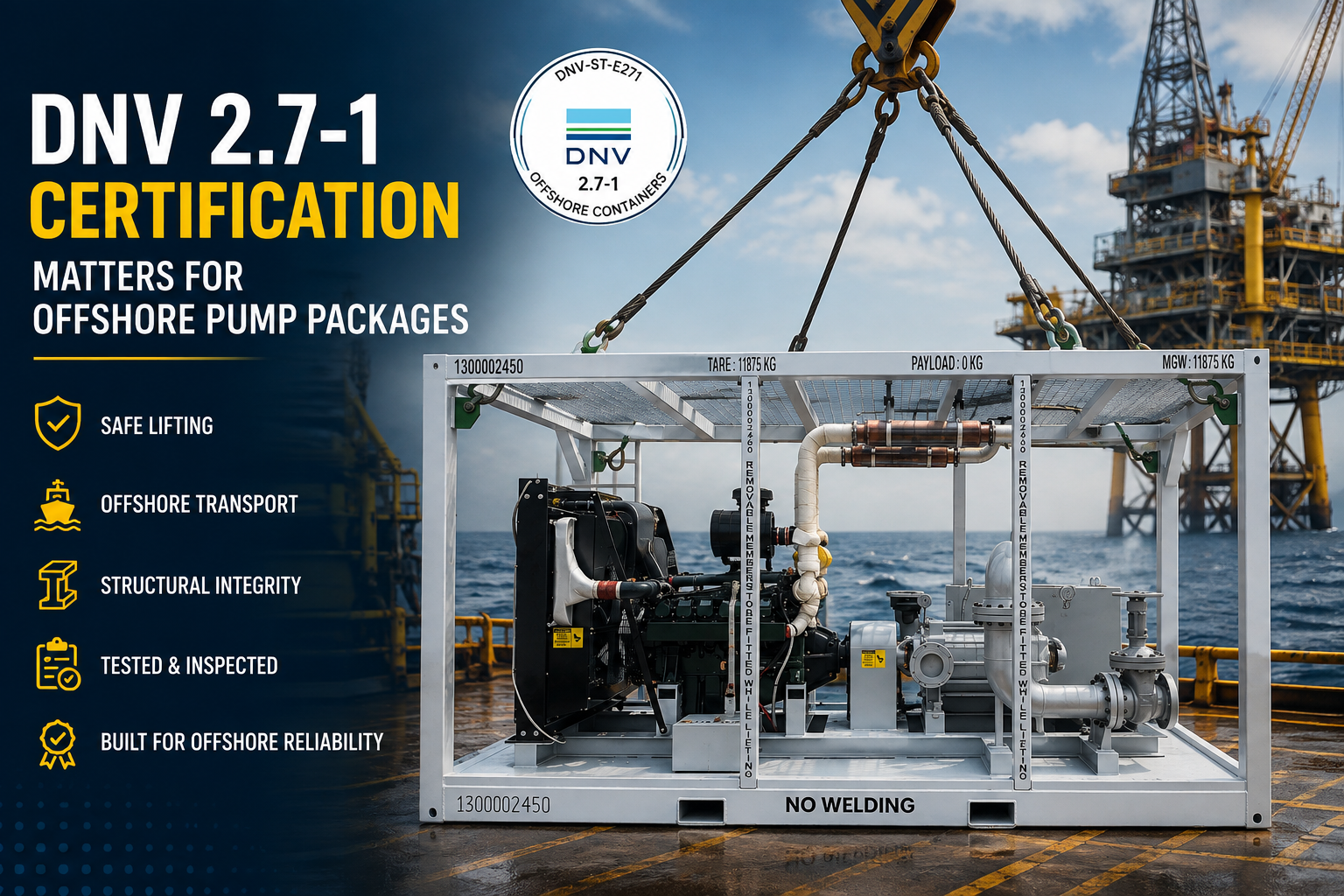
Offshore pump packages must do more than deliver the required flow and pressure. They must also be safe to transport, lift, position, and operate in demanding offshore environments. This is especially important when a pump package needs to be moved between a supply vessel, offshore platform, rig, or other marine facility. This is where DNV 2.7-1 certification becomes important.
DNV 2.7-1 is a recognized offshore standard covering requirements for offshore containers and lifting sets. The current standard is designated DNV-ST-E271, and DNV states that it covers approval and certification requirements related to design, manufacturing, testing, marking, and periodic inspection.
For offshore pump packages, however, it is important to understand exactly what the certification means. DNV 2.7-1 certification applies to the offshore container or applicable transport and lifting arrangement, rather than automatically certifying the pump itself. The pump, engine, piping, valves, controls, and other equipment still need to meet their applicable technical and safety requirements.
So, why does DNV 2.7-1 certification matter for offshore pump packages? The answer comes down to safe lifting, offshore transportation, structural integrity, documentation, reliability, and customer confidence.
What Is DNV 2.7-1 Certification?
DNV 2.7-1 is a certification standard developed for equipment intended to be transported and handled offshore.
The standard is particularly relevant to equipment that may be:
- Lifted by crane
- Transported between offshore installations and vessels
- Exposed to harsh environmental conditions
- Handled repeatedly during offshore operations
- Used as temporary equipment on offshore installations
DNV explains that offshore temporary equipment needs to be safe to transport and lift in potentially harsh offshore environments. It also needs to be safe to operate on the installation where it is used.
Therefore, DNV 2.7-1 is not simply about the pump itself. It is highly relevant to the complete offshore package, including its supporting structure and lifting arrangements.
Why Is DNV 2.7-1 Important for Offshore Pump Packages?
An offshore pump package may need to be transported by vessel, lifted onto a platform, moved around the installation, and operated in a demanding environment.
Each of these activities introduces risks.
A properly engineered and certified package helps address these risks by considering the equipment’s structural integrity, lifting requirements, testing, marking, and inspection.
Here are some of the main reasons DNV 2.7-1 certification matters.
1. Safer Offshore Lifting
Offshore pump packages are often moved using cranes. Unlike equipment that remains permanently installed onshore, an offshore pump package may be lifted several times during its service life.
For this reason, the skid or container structure must be suitable for lifting.
DNV 2.7-1 includes requirements for offshore containers and lifting sets. The certification process covers important aspects of design, manufacturing, testing, marking, and inspection.
This gives operators greater confidence when moving heavy pump equipment between locations.
2. Designed for Offshore Handling
Offshore logistics can be very different from onshore transportation.
Equipment may be loaded onto supply vessels, transferred to offshore platforms, lifted by cranes, and moved across restricted working areas.
A pump package designed for offshore use should therefore consider more than pump performance.
The complete package should be engineered with handling and transportation requirements in mind.
This can include the:
- Skid structure
- Lifting points
- Lifting sets
- Equipment layout
- Access arrangements
- Identification and marking
- Protection of components
DNV certification provides a structured approach to these requirements.
3. Greater Structural Confidence
A high-pressure pump can be a heavy piece of industrial equipment. When the pump, engine, piping, valves, controls, fuel system, and accessories are installed on one skid, the total package can become significantly heavier.
The skid must therefore support the equipment during lifting and transportation.
A certified offshore package is assessed against applicable structural and lifting requirements rather than being treated simply as an ordinary industrial skid.
This is particularly important when equipment will be repeatedly transported offshore.
4. Better Risk Management
Offshore projects operate in environments where access to equipment can be difficult and weather conditions can change quickly.
A failure during lifting or transportation can cause:
- Equipment damage
- Project delays
- Personnel safety risks
- Additional logistics costs
- Unplanned maintenance
- Production interruptions
For this reason, offshore operators place strong emphasis on equipment reliability and safe handling.
DNV describes temporary offshore equipment as an area that requires attention because it can introduce new risks to an offshore installation or affect existing equipment.
Certification helps demonstrate that these risks have been considered during the equipment’s design and approval process.
What Does DNV 2.7-1 Cover?
It is important to understand that DNV 2.7-1 is not a pump performance standard.
It does not replace the technical requirements needed to select a pump for a particular application.
Instead, it focuses on the offshore container and lifting aspects of the equipment.
According to DNV, DNV-ST-E271 includes requirements and guidance for the approval and certification of offshore containers and lifting sets. These requirements address both new-build and in-service containers, including manufacturing, testing, marking, and periodic inspection.
For an offshore pump package, this means the certification should be considered as part of the overall package design.
Pump performance remains important, but the package must also be suitable for the way it will be transported, lifted, and used offshore.
DNV 2.7-1 and Offshore Pump Skids
Many offshore pump systems are built as skid-mounted packages.
A typical package can include:
- High-pressure pump
- Diesel engine or electric motor
- Gearbox or coupling
- Fuel system
- Piping and manifolds
- Pressure gauges
- Valves
- Control panel
- Emergency shutdown system
- Protective guards
- Lifting frame or lifting points
- Structural skid
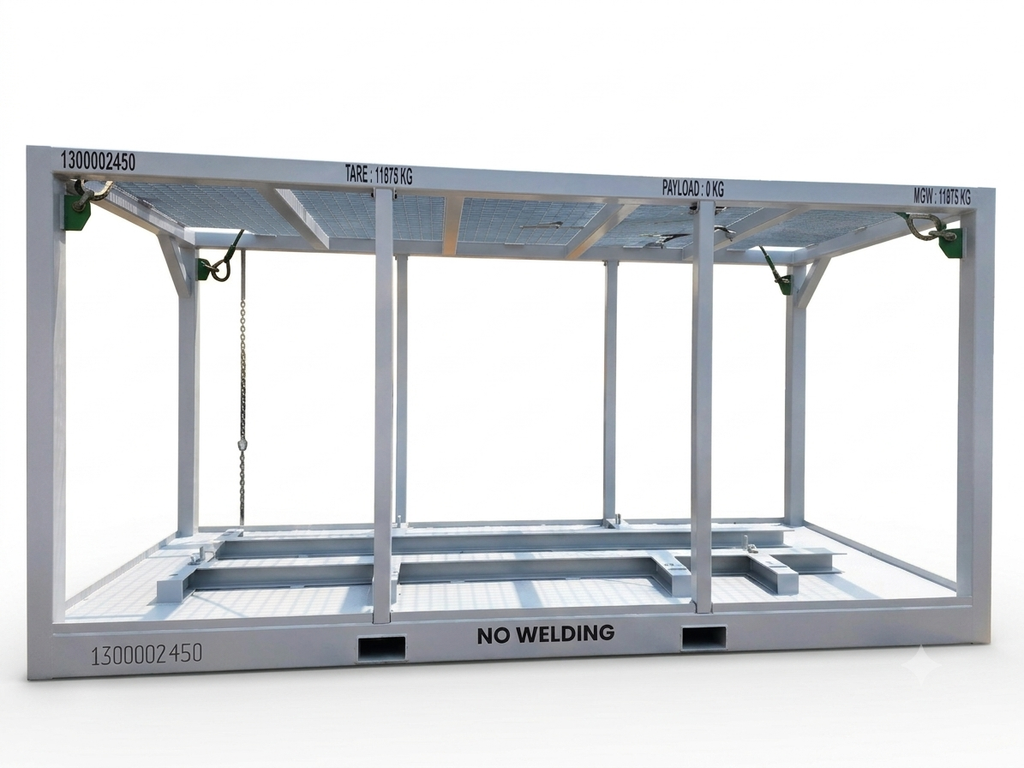
When this equipment is intended for offshore use, the skid becomes an important part of the overall package.
The pump may perform correctly on a test bench. However, that does not automatically mean the complete package is suitable for offshore transportation and lifting.
This distinction is important.
Pump performance and offshore certification address different requirements.
DNV 2.7-1 vs. Pump Performance
A pump package can have excellent hydraulic performance while still requiring additional engineering for offshore deployment.
For example, engineers may need to consider:
| Pump Requirement | Offshore Package Requirement |
|---|---|
| Flow rate | Safe lifting |
| Discharge pressure | Skid structural integrity |
| Pump efficiency | Lifting points |
| Engine power | Offshore transportation |
| Fluid compatibility | Equipment protection |
| Operating temperature | Marking and identification |
| Pressure rating | Inspection and testing |
This is why offshore equipment selection should consider both technical performance and certification requirements.
Why Certification Matters to Offshore Operators
For operators, contractors, and project managers, certification can simplify the process of evaluating equipment for offshore deployment.
A recognized certification provides documented evidence that the equipment has gone through an applicable certification process.
DNV states that its certification activities can include design assessment, manufacturing and testing surveillance, and final inspection, depending on the certification scope.
This documentation can be valuable during:
- Equipment approval
- Project tendering
- Client inspections
- Offshore mobilization
- Equipment handover
- Audits
- Maintenance planning
It also gives project stakeholders greater confidence in the equipment they are receiving.
Supporting Offshore Logistics
Moving equipment offshore requires careful planning.
A pump package may travel through several stages before reaching its final operating location:
Workshop → Transport Vehicle → Port → Supply Vessel → Offshore Installation → Operating Location
At each stage, the package may be lifted, secured, transported, or repositioned.
A package designed for offshore handling can make these activities more predictable.
This can reduce the risk of damage during transportation and help improve the efficiency of offshore mobilization.
Why Lifting Points Are Critical
One of the most important considerations for any heavy offshore package is lifting.
Lifting points must be correctly designed, positioned, identified, and used according to the applicable requirements.
Incorrect lifting can place excessive loads on the skid or equipment.
It can also create a serious personnel safety hazard.
For this reason, offshore pump packages should have clearly defined lifting arrangements and appropriate documentation.
Operators should never assume that a standard lifting lug or forklift pocket is automatically suitable for offshore lifting.
The lifting arrangement should be engineered and certified for its intended application.
Certification Can Improve Project Confidence
Offshore projects involve many different stakeholders.
These can include:
- Equipment manufacturers
- EPC contractors
- Offshore operators
- Marine contractors
- Inspection companies
- Classification societies
- Maintenance contractors
- Logistics providers
Each party needs confidence that the equipment can be safely handled and deployed.
A recognized certification can help establish a common technical reference point.
As a result, certification can support smoother equipment approval and reduce uncertainty during project planning.
DNV 2.7-1 Is Not a Substitute for Other Certifications
One important point should be made clear.
DNV 2.7-1 certification does not automatically mean that an entire pump package complies with every offshore requirement.
Different projects can have different requirements.
Depending on the application, additional requirements may apply to:
- Electrical systems
- Hazardous-area classification
- Pressure equipment
- Engine emissions
- Fire protection
- Emergency shutdown systems
- Noise
- Fuel systems
- Control systems
- Client-specific specifications
- Local regulations
- Vessel or installation requirements
Therefore, the project specification should always be reviewed before selecting or manufacturing an offshore pump package.
DNV 2.7-1 and Offshore High-Pressure Pump Packages
High-pressure pump packages are commonly used for demanding offshore applications.
These can include:
- Hydrostatic testing
- Pipeline testing
- Pipeline commissioning
- Flushing
- Cleaning
- Water injection
- Maintenance activities
- Pressure testing
- General offshore utility services
For these applications, the pump may need to provide high pressure and reliable flow while also being transported and handled safely offshore.
A DNV 2.7-1 certified skid can therefore be an important feature when the equipment is intended for repeated offshore deployment.
What Should You Check When Selecting a Certified Offshore Pump Package?
When purchasing or renting an offshore pump package, do not look only at the words “DNV 2.7-1.”
Ask for the relevant certification and technical documentation.
Important items to check include:
1. Certification Documentation
Confirm that the equipment has appropriate certification documentation and that the certificate applies to the equipment being supplied.
2. Identification and Marking
Check that the package has the required identification and marking.
3. Lifting Arrangement
Review the lifting points, lifting set, safe working load, and lifting documentation.
4. Structural Design
Confirm that the skid and supporting structure are suitable for the intended offshore service.
5. Inspection Records
Ask for relevant inspection and testing records.
6. Equipment Condition
For rental or previously used equipment, check the inspection status and maintenance history.
DNV’s current standard also addresses in-service containers and periodic inspection, highlighting the importance of continued condition and compliance rather than certification being viewed as a one-time consideration.
DNV 2.7-1 for Rental Pump Packages
Certification can be particularly useful for rental equipment.
Rental pump packages may move between multiple projects and offshore locations. As a result, they can experience repeated transportation, lifting, installation, and removal.
For rental customers, a certified package can provide additional confidence before mobilization.
However, the certification should always be checked against the specific equipment, current inspection status, and project requirements.
A certified package should also be properly maintained between deployments.
Why Offshore Certification Adds Value
Offshore equipment often operates where replacing or repairing a failed component can be difficult.
A pump package failure may require equipment to be returned to shore or may require specialist personnel and spare parts to be transported offshore.
This can result in significant downtime.
Therefore, selecting equipment that has been properly engineered, inspected, documented, and maintained can contribute to better project reliability.
Certification is one part of this overall approach.
It should work together with proper engineering, maintenance, inspection, operator training, and safe operating procedures.
The Importance of the Complete Package
When evaluating an offshore pump, it is easy to focus on the pump model, pressure, and flow rate. However, offshore applications require a wider view. The complete package matters. A high-pressure pump with the required performance may not be suitable for offshore deployment if the supporting skid, lifting arrangement, controls, or other components do not meet the project’s requirements. For this reason, offshore pump packages should be engineered as complete systems.
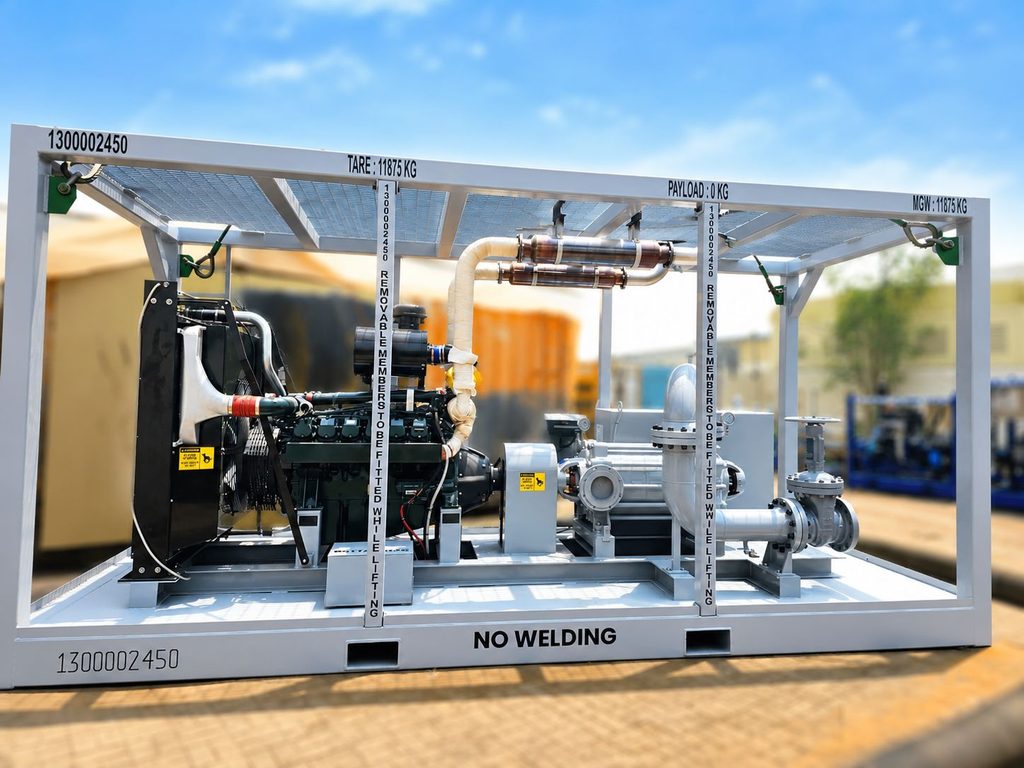
DNV 2.7-1: A Practical Offshore Advantage
DNV 2.7-1 certification can provide an important advantage when equipment is designed for offshore transportation and handling.
It helps address a critical question:
Can this equipment be safely transported, lifted, handled, and used in the offshore environment?
While certification does not eliminate every operational risk, it provides a recognized framework for addressing key offshore equipment requirements.
For operators and contractors, this can translate into greater confidence during equipment selection and mobilization.
Conclusion
DNV 2.7-1 certification matters for offshore pump packages because offshore equipment must do more than deliver the required pressure and flow.
It must also be suitable for transportation, lifting, handling, and deployment in demanding offshore conditions.
DNV-ST-E271 2.7-1 provides requirements for offshore containers and lifting sets, including areas such as design, manufacturing, testing, marking, and inspection.
For offshore pump packages, this makes certification an important consideration when designing, purchasing, or renting equipment for offshore projects.
However, DNV 2.7-1 should be viewed as one part of the overall equipment specification. Project-specific requirements, hazardous-area requirements, pressure ratings, electrical standards, client specifications, and other applicable regulations must also be considered.
Ultimately, the right offshore pump package combines reliable pump performance, robust package design, safe lifting arrangements, proper documentation, and appropriate certification.
That combination helps equipment perform reliably from the workshop to the offshore installation.
Final Takeaway
When selecting an offshore pump package, don’t ask only:
“Can this pump deliver the required pressure and flow?”
Also ask:
“Is the complete package engineered and certified for the way it will be transported, lifted, and used offshore?”
That is where DNV 2.7-1 certification can make a significant difference.