✉️ [email protected] | 📞 +971-4-2675252

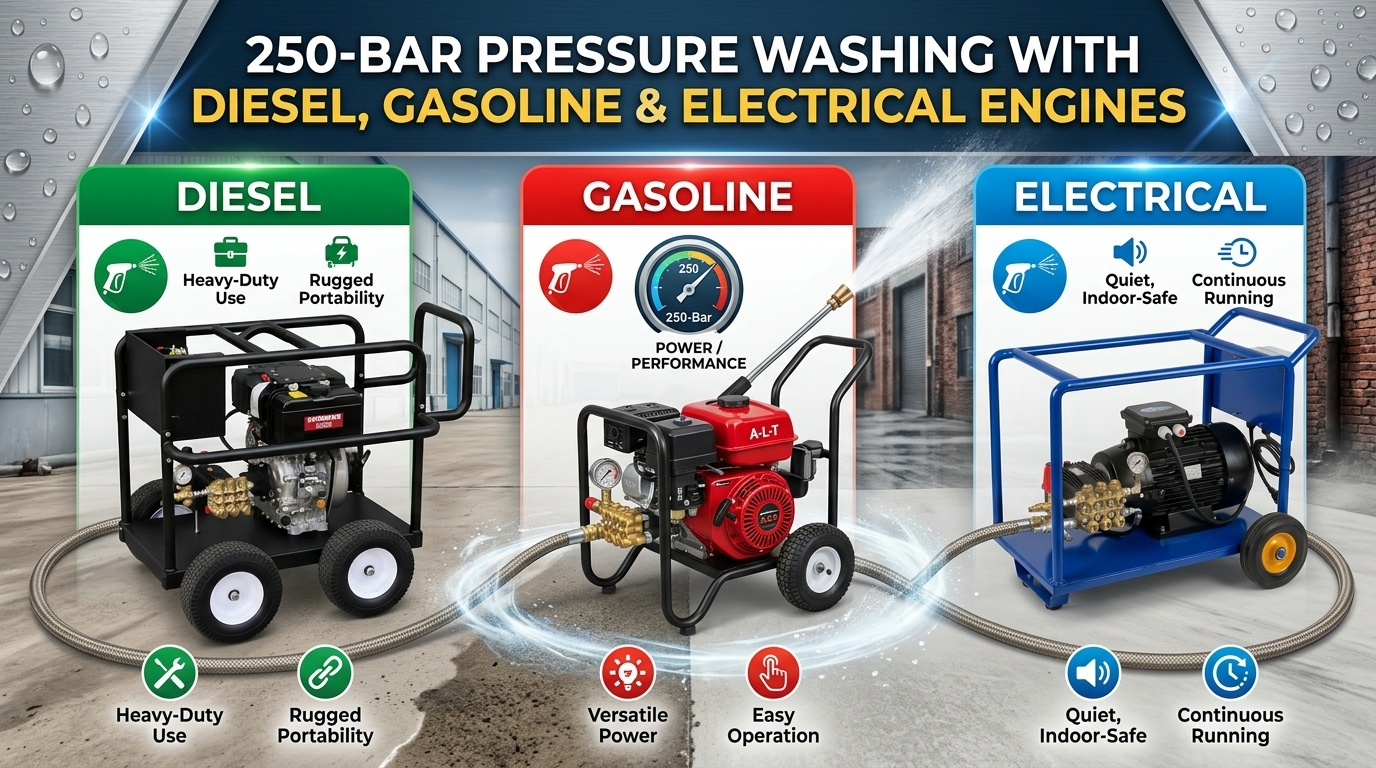

When standard pressure washing is not enough, 250 Bar pressure washing can provide the extra cleaning force needed for demanding industrial and commercial jobs. Higher pressure helps remove stubborn dirt, coatings, grease, deposits, and other contaminants from suitable surfaces.
However, pressure alone does not determine cleaning performance. The pump, flow rate, power source, hose, nozzle, and operating controls must work together. A 250 Bar system can be powered by a diesel engine, gasoline engine, or electric motor. Each option has different advantages. Therefore, choosing the right power source is important for safe and reliable operation.
This article explains when 250 Bar pressure washing makes sense, how higher pressure affects cleaning, and how to match the pump to the available power source.
What Is 250-Bar Pressure Washing?
250 Bar pressure washing uses a high-pressure pump capable of producing up to 250 Bar of working pressure, depending on the equipment configuration. For reference, 250 Bar is approximately 3,626 psi.
This pressure level provides significantly more force than many conventional pressure washers. As a result, it can help remove difficult contamination from industrial surfaces. However, higher pressure does not always mean better cleaning.
The correct pressure depends on:
- Surface material
- Type of contamination
- Required cleaning result
- Water flow rate
- Nozzle type
- Cleaning distance
- Pump configuration
- Available power source
Therefore, the goal should be to use the right pressure and flow for the application, rather than simply selecting the highest available pressure.
Why Use 250 Bar Pressure Washing?
The main advantage of 250 Bar pressure washing is the additional cleaning force. A high-pressure water jet can break the bond between dirt and a surface. It can also help remove deposits that are difficult to clean with lower-pressure equipment.
Depending on the application, 250 Bar systems can be used for:
- Heavy-duty equipment cleaning
- Industrial pressure washing
- Concrete and surface cleaning
- Machinery cleaning
- Tank and vessel cleaning
- Pipeline maintenance
- Plant maintenance
- Marine and offshore cleaning
- Construction equipment cleaning
- Surface preparation
The actual result depends on both pressure and water flow. For example, a pump producing high pressure but very low flow may not remove material as quickly as a system designed for a higher flow rate. Therefore, both values should be considered when selecting equipment.
When Does 250 Bar Pressure Make Sense?
Not every cleaning job requires 250 Bar. For light dirt, dust, and general washing, lower-pressure equipment may be sufficient. However, higher pressure becomes useful when the contamination is strongly bonded to the surface.
1. Heavy Dirt and Deposits
Industrial equipment can collect oil, grease, mud, scale, and other deposits over time. A 250 Bar water jet provides additional impact against these contaminants. This can reduce the amount of manual cleaning required.
2. Equipment Maintenance
Heavy machinery often needs regular cleaning before inspection or maintenance. High-pressure water can help remove accumulated dirt from equipment surfaces, making components easier to inspect.
3. Industrial Cleaning
Factories, workshops, plants, and other industrial facilities may require stronger cleaning equipment. In these environments, a 250 Bar system can provide the cleaning force needed for demanding applications.
4. Surface Preparation
Some surfaces require cleaning before painting, coating, inspection, or maintenance. In such cases, pressure washing can help remove loose contamination and surface deposits. However, the pressure must be selected carefully to avoid damaging the underlying material.
Pressure Is Not the Only Factor
It is easy to focus on the 250 Bar pressure rating. However, pressure is only one part of the cleaning system.
➡️Pressure
Pressure determines the force available at the water jet. Higher pressure can increase the impact of the water on the surface. However, excessive pressure can damage some materials.
➡️Flow Rate
Flow rate determines how much water the system delivers. A higher flow can help move loosened dirt away from the surface. Therefore, pressure and flow should be considered together.
➡️Nozzle
The nozzle controls how the water leaves the system. Different nozzles produce different spray patterns and jet characteristics. Choosing the correct nozzle helps direct the available pressure and flow toward the cleaning task.
➡️Cleaning Distance
The distance between the nozzle and surface also affects cleaning performance. Holding the nozzle too close can damage sensitive surfaces. On the other hand, holding it too far away can reduce the cleaning effect.
Consider the Surface Before Using 250 Bar
High-pressure water is powerful. Therefore, the surface must always be considered before starting the job.
➡️Metal Surfaces
Metal surfaces can generally tolerate high-pressure cleaning when the pressure, nozzle, and distance are suitable. However, painted surfaces, coatings, seals, electrical components, and damaged areas may require additional care.
➡️Concrete
Concrete can require strong cleaning force, especially when removing dirt, mud, or other deposits. However, damaged or weak concrete can be affected by high-pressure water. Operators should therefore assess the surface before cleaning.
➡️Painted and Coated Surfaces
Paint and protective coatings may be damaged by excessive pressure. For these surfaces, start with a controlled pressure and increase it only when necessary.
➡️Sensitive Components
Bearings, electrical connections, seals, instruments, and other sensitive components may not be suitable for direct high-pressure water exposure. A suitable cleaning method should protect these components from water and excessive pressure.
Diesel, Gasoline or Electric Power?
A 250 Bar pump needs a suitable power source to operate correctly. Three common options are diesel engines, gasoline engines, and electric motors. The best option depends on the location, available power, operating conditions, and required mobility.
➡️Diesel-Driven 250 Bar Pressure Washing
Diesel-driven systems are useful for demanding industrial applications where mobility and independent operation are important. A diesel engine can drive the high-pressure pump without requiring a fixed electrical supply.
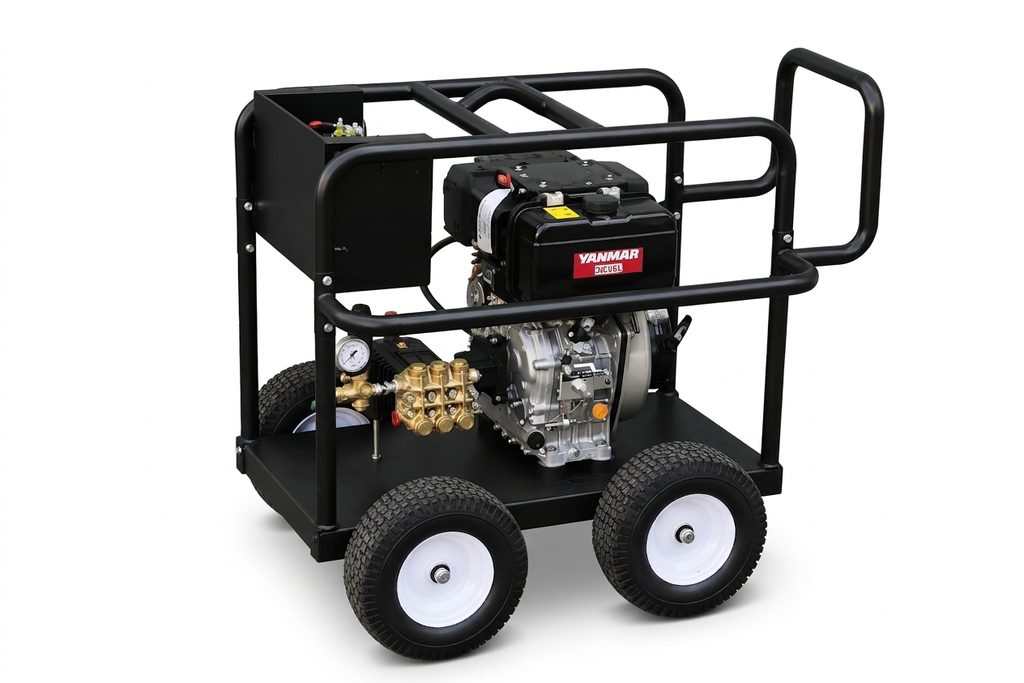
This can be useful for:
- Remote work areas
- Construction sites
- Industrial maintenance
- Outdoor cleaning
- Shutdown projects
- Large equipment cleaning
Diesel-driven units can also be designed as skid-mounted or trailer-mounted systems, depending on project requirements. However, operators must consider fuel, ventilation, exhaust, noise, and maintenance requirements.
➡️Gasoline-Driven 250 Bar Pressure Washing
Gasoline engines provide another option for mobile high-pressure cleaning equipment. They can be useful when a compact and independent power source is required.
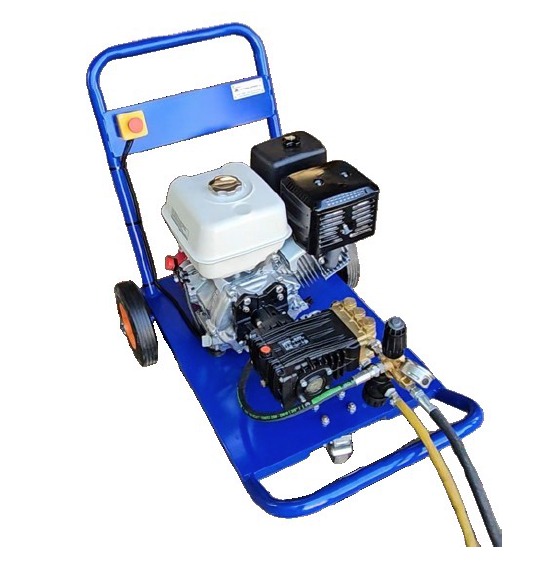
Gasoline-powered systems can support applications such as:
- Mobile pressure washing
- Construction equipment cleaning
- General industrial maintenance
- Outdoor cleaning
- Remote applications
As with diesel equipment, operators should consider fuel requirements, ventilation, exhaust, noise, and operating conditions.
➡️Electric-Driven 250 Bar Pressure Washing
Electric motors can be a practical choice when a suitable electrical supply is available. Electric-driven systems are often suitable for workshops, factories, plants, and other controlled environments.
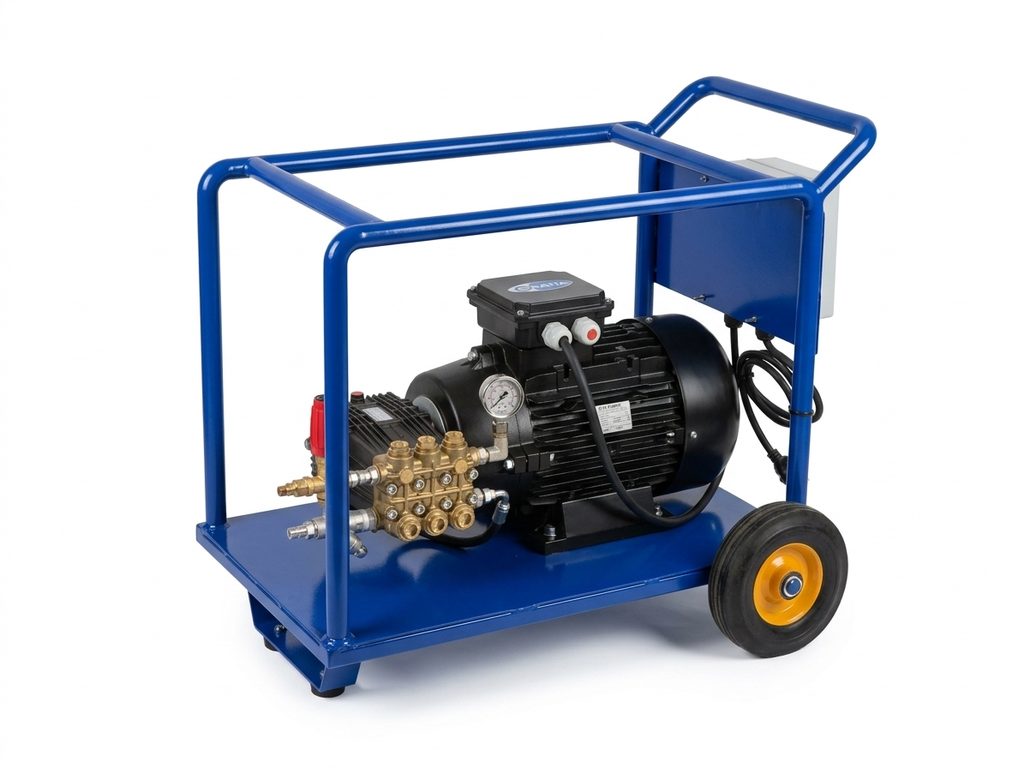
They can offer:
- Easy starting
- Consistent operation
- No engine exhaust at the point of use
- Convenient operation in suitable indoor environments
- Integration with fixed electrical supplies
However, the available electrical supply must match the motor requirements. For example, voltage, phase, frequency, motor power, and starting requirements should all be checked before selecting the pump package.
Match the Pump to the Power Source
One of the most important steps in designing a 250 Bar pressure washing system is matching the pump to the power source. The pump requires sufficient input power to produce the required pressure and flow. If the power source is undersized, the system may not achieve the required performance. Therefore, the equipment should be selected based on the complete operating requirement.
Consider:
- Required pressure
- Required flow rate
- Pump efficiency
- Engine or motor power
- Operating speed
- Duty cycle
- Drive arrangement
- Application requirements
A properly matched system allows the pump and power source to operate within their intended working range.
Why Pump Selection Matters
The high-pressure pump is the heart of the system. A suitable pump should be selected according to the required pressure, flow, fluid, operating time, and application. For example, a pump designed for one operating condition may not be suitable for another application simply because it has the same pressure rating. Therefore, do not select a pump based on pressure alone. A proper selection should consider pressure, flow, power, operating speed, and duty cycle together.
250 Bar Pressure Washing: Safety Considerations
At 250 Bar, water can cause serious injury and surface damage if the equipment is used incorrectly. Operators should follow the equipment manufacturer’s instructions and use appropriate personal protective equipment.
Important precautions include:
- Inspect hoses before operation.
- Check high-pressure connections.
- Use the correct nozzle.
- Keep the jet away from people.
- Do not point the water jet at electrical equipment unless the equipment is specifically designed for it.
- Maintain a safe working distance.
- Check the surface before increasing pressure.
- Use suitable protective clothing and eye protection.
- Stop the system before making adjustments.
In addition, operators should understand the pressure controls and emergency shutdown system before starting work.
Choosing the Right 250 Bar System
➡️Before selecting a 250 Bar pressure washing unit, define the actual cleaning requirement.
➡️Start by identifying the contamination and surface.
➡️Next, determine the required pressure and flow. Then, select the appropriate pump and power source.
➡️Finally, consider the operating environment and equipment configuration.
A simple selection process is:
Application → Surface → Pressure → Flow → Pump → Power Source → Controls
This approach helps prevent the common mistake of selecting equipment based only on maximum pressure.
250 Bar Pressure Washing for Industrial Applications
250 Bar systems can provide useful cleaning power for a wide range of industrial applications. Depending on the equipment configuration, they can support:
- Industrial equipment washing
- Machinery cleaning
- Plant maintenance
- Tank cleaning
- Marine cleaning
- Construction equipment cleaning
- Surface preparation
- Pipeline maintenance
- Workshop cleaning
- General heavy-duty pressure washing
The exact application should determine the required pump specification and power source.
Final Thoughts
250 Bar pressure washing can provide the extra cleaning force required for demanding applications. However, higher pressure is not automatically the right solution for every surface or cleaning task. The best results come from matching the pressure, flow, pump, nozzle, surface, and power source to the application.
Diesel-powered systems can provide mobility for demanding outdoor work. Gasoline-powered systems can offer a compact mobile solution. Electric-driven systems can be practical where a suitable electrical supply is available. Most importantly, the pump and power source must be properly matched.
A correctly designed 250 Bar system can provide reliable cleaning performance while helping operators work efficiently and safely. For industrial cleaning requirements, Al Khamis Equipment LLC can support the selection of high-pressure pump packages based on the required pressure, flow rate, power source, and application.