✉️ [email protected] | 📞 +971-4-2675252

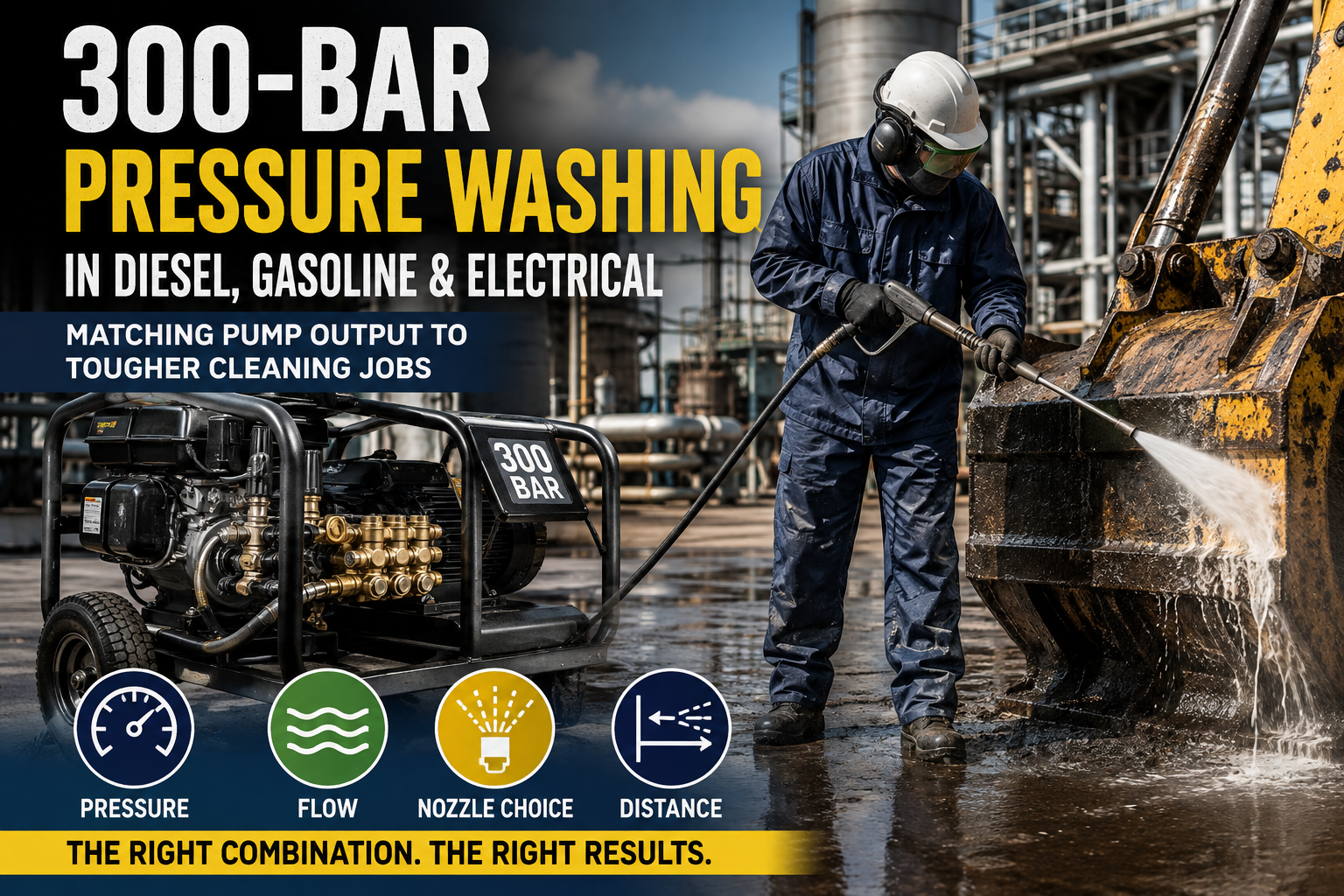

High-pressure cleaning becomes more demanding when standard pressure washers cannot remove tough dirt, coatings, grease, and deposits. 300-bar pressure washing provides higher cleaning force for industrial and heavy-duty applications. However, pressure alone does not determine cleaning performance.
The pump must deliver the right combination of pressure and flow. In addition, nozzle size, spray pattern, and working distance can greatly affect the final result. The power source also matters because diesel, gasoline, and electric engines suit different operating conditions.
For this reason, choosing the correct 300-bar pressure washing system starts with understanding the complete setup.
What Is 300-Bar Pressure Washing?
300 bar is equal to approximately 4,350 psi. At this pressure level, water can provide strong cleaning action when the pump, hose, gun, and nozzle are correctly matched.
300-bar pressure washing can be used for applications such as:
- Heavy-duty equipment cleaning
- Industrial surface cleaning
- Concrete and hard-surface cleaning
- Oil and grease removal
- Pipeline and plant maintenance
- Tank and vessel cleaning
- Machinery cleaning
- Marine and offshore cleaning
- Surface preparation
- General industrial washing
However, not every job requires 300 bar. Using excessive pressure on a delicate surface can cause damage. Therefore, operators should always match the equipment to the surface and cleaning requirement.
Pressure and Flow Work Together
Flow and Pressure are two of the most important factors in pressure washing. Pressure provides the force needed to break dirt away from the surface. Flow rate determines how much water reaches the surface and helps carry loosened dirt away.
For example, a system with high pressure but low flow can provide a strong concentrated jet. On the other hand, a system with high flow can move more water across a larger area. Therefore, the best cleaning result does not always come from choosing the highest pressure available.
Why Flow Rate Matters
Flow rate is usually measured in litres per minute (L/min) or cubic metres per hour (m³/hr).
A higher flow rate can help with:
- Removing loose debris
- Rinsing large surfaces
- Moving dirt away from the work area
- Covering larger areas
- Improving cleaning productivity
Consequently, the pump should be selected based on both the required pressure and the required flow.
How Nozzle Choice Affects Cleaning
The nozzle controls how water leaves the pressure washer. As a result, nozzle selection can change the cleaning pattern and the force applied to the surface.
Different nozzle types can be used for different applications.
➡️Narrow Spray Pattern
A narrow spray concentrates the water into a smaller area. This can provide strong cleaning action for stubborn deposits. However, the operator should use care because concentrated spray can damage some surfaces.
➡️Wider Spray Pattern
A wider spray covers more surface area. It can be useful for general washing and rinsing. Although the cleaning force is spread over a larger area, it can improve coverage and reduce cleaning time on suitable surfaces.
➡️Rotary Nozzles
Rotary nozzles create a rotating spray pattern. They can help improve cleaning coverage on hard surfaces. They are often useful for removing stubborn dirt from suitable concrete and industrial surfaces.
Working Distance Changes the Cleaning Result
The distance between the nozzle and the surface also affects cleaning performance. When the nozzle is closer to the surface, the water jet delivers more concentrated cleaning action to a smaller area. When the nozzle moves farther away, the spray spreads out and the impact on the surface decreases. Therefore, operators should maintain a suitable working distance for the application.
For example:
Too close: The surface may be damaged.
Too far: Cleaning performance may decrease.
Correct distance: The operator can achieve effective cleaning while controlling the risk of surface damage.
The correct distance depends on the surface, nozzle, pressure, flow, and type of contamination.
Matching 300-Bar Pressure to the Job
A 300-bar system can provide strong cleaning performance. However, the correct pump output depends on the actual job.
Before selecting a pump, consider:
- Required pressure
- Required flow rate
- Surface material
- Type of contamination
- Required cleaning area
- Nozzle type
- Working distance
- Available power source
This approach helps ensure that the pump is not selected based on pressure alone.
➡️Diesel-Powered 300-Bar Pressure Washing
Diesel-driven pressure washing systems are useful when high-pressure cleaning is required at locations where electrical power may not be readily available. A diesel engine can drive the high-pressure pump directly. Therefore, the system can be suitable for outdoor and industrial applications.
Typical applications can include:
- Construction sites
- Pipeline maintenance
- Oil and gas facilities
- Industrial plants
- Marine applications
- Remote cleaning locations
- Heavy equipment cleaning
The final pump output should still be matched to the engine power, pressure requirement, and flow rate.
➡️Gasoline-Powered 300-Bar Pressure Washing
Gasoline-powered systems can provide a compact option for certain high-pressure cleaning applications. They can be useful where mobility and independent operation are important. However, the selected gasoline engine must have enough power to operate the pump at the required pressure and flow. As with diesel systems, operators should consider the complete pump package rather than pressure alone.
➡️Electric-Powered 300-Bar Pressure Washing
Electric-driven systems can be suitable for locations with a reliable electrical supply. They can be used in industrial facilities, workshops, maintenance areas, and other locations where electrical power is available. However, the electrical supply must match the motor requirements. Operators should check voltage, phase, frequency, motor power, and available electrical capacity before selecting the system.
Choosing the Right Pump Output
A 300-bar pump can produce very different cleaning results depending on its flow rate. For example, two pumps may both operate at 300 bar but have different flow rates. The higher-flow system can move more water across the surface, while the lower-flow system may provide a more concentrated cleaning action. Therefore, the correct question is not simply:
“Do I need a 300-bar pump?”
Instead, consider:
“What pressure and flow do I need for this cleaning job?”
This helps create a more suitable and efficient pressure washing system.
Surface Type Must Be Considered
Different surfaces require different cleaning approaches. Concrete and heavy industrial surfaces may tolerate higher cleaning force. However, painted surfaces, coatings, equipment components, and sensitive materials may require more controlled pressure.
Before starting the job, check:
- Surface material
- Coating condition
- Existing damage
- Type of contamination
- Required cleaning level
- Recommended operating pressure
Most importantly, begin with a controlled test area when the surface response is uncertain.
Safety Is Essential at 300 Bar
At 300 bar, high-pressure water can cause serious injury and surface damage if the equipment is used incorrectly. Operators should use suitable personal protective equipment and follow the equipment manufacturer’s instructions.
Important safety practices include:
- Inspect hoses before use.
- Check fittings and connections.
- Use the correct rated components.
- Never point the water jet at people.
- Keep unnecessary personnel away from the work area.
- Use the correct nozzle for the application.
- Maintain a controlled working distance.
- Shut down the system before maintenance.
- Follow the pump and engine manufacturer’s operating instructions.
Furthermore, high-pressure systems should be operated only by trained personnel who understand the equipment and application.
Why the Complete System Matters
A pressure washer is more than just a pump. The pump, engine or electric motor, hose, gun, nozzle, valves, fittings, and safety components must work together.
For example, a pump may be capable of 300 bar, but the cleaning system must have components that are correctly rated for the operating conditions. Therefore, a complete 300-bar pressure washing system should be selected according to the required pressure, flow, power source, application, and operating environment.
When Does 300-Bar Pressure Washing Make Sense?
300-bar pressure washing can be considered when standard pressure levels are not providing enough cleaning force for the application.
It may be suitable for:
- Tough industrial cleaning
- Heavy equipment washing
- Concrete cleaning
- Pipeline maintenance
- Marine maintenance
- Tank and vessel cleaning
- Surface preparation
- Removal of stubborn dirt and deposits
However, higher pressure is not automatically better. The right combination of pressure, flow, nozzle and distance is what determines the cleaning result.
Final Thoughts
Effective 300-bar pressure washing requires more than selecting a high-pressure pump. Pressure provides cleaning force, while flow helps move water and loosened contamination. At the same time, nozzle selection and working distance affect how that force reaches the surface.
The power source is also important. Diesel, gasoline, and electric-driven systems can each suit different operating conditions. Therefore, before choosing a 300-bar pressure washing system, evaluate the cleaning application, surface, required flow, nozzle, working distance, and available power source. A correctly matched pump package can provide effective cleaning while helping operators work safely and efficiently.