✉️ [email protected] | 📞 +971-4-2675252


Introduction
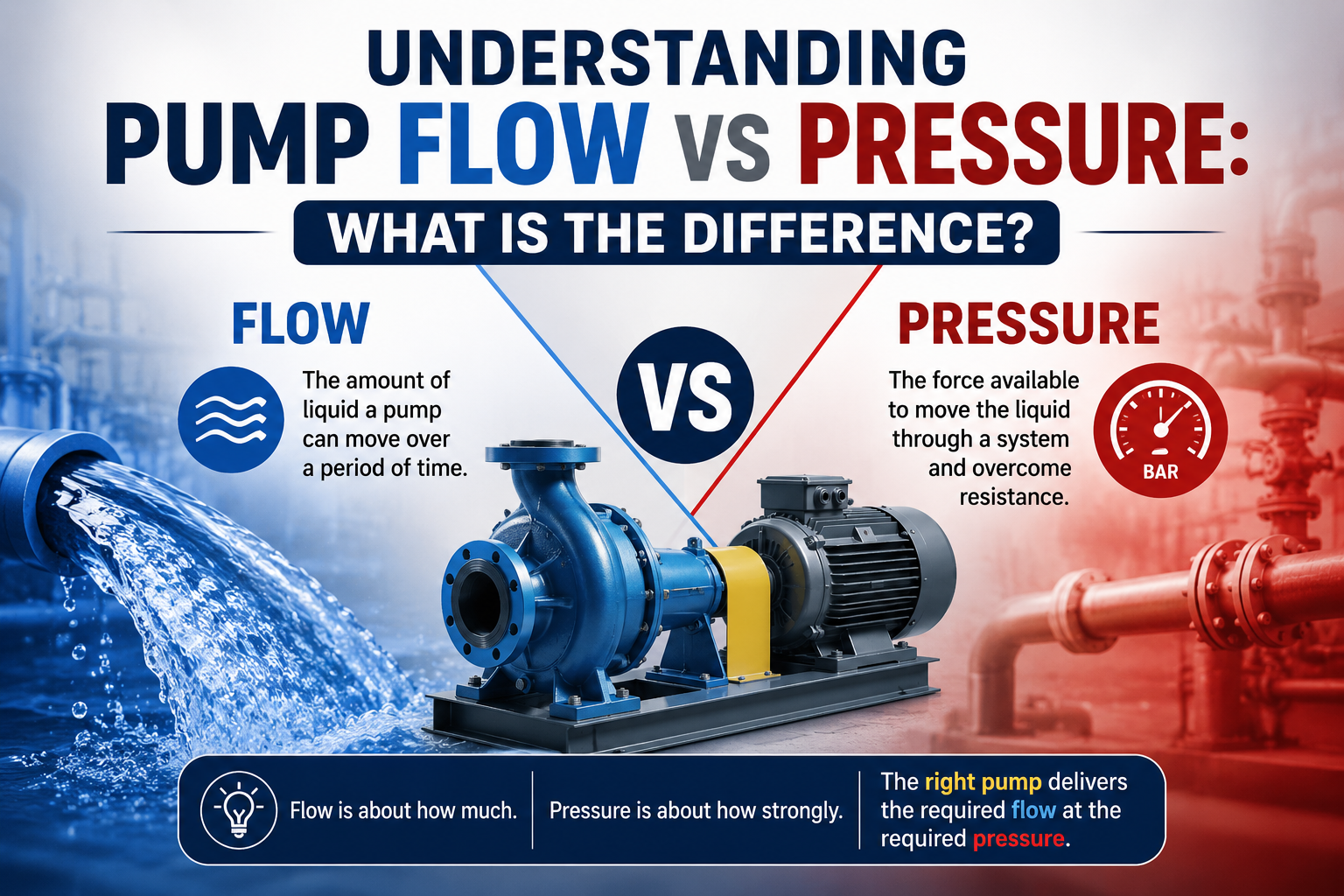
Understanding pump flow vs pressure is important when selecting the right pump for an industrial application. Although flow and pressure are closely related, they describe two different things. In simple terms, flow tells you how much liquid a pump can move over a certain period. On the other hand, pressure tells you how much force is available to move that liquid through a system. Therefore, looking at only flow or only pressure is not enough when choosing a pump. Instead, you need to understand how both work together. In this article, we explain the difference between pump flow and pressure, how they affect pump performance, and why both are important for industrial pumping applications.
What Is Pump Flow?
Pump flow is the amount of liquid a pump can move within a specific period.
Flow is commonly measured in:
- Litres per minute (L/min)
- Cubic metres per hour (m³/hr)
- Gallons per minute (GPM)
For example, if a pump has a flow rate of 100 m³/hr, it can move up to 100 cubic metres of liquid in one hour under the specified operating conditions. However, the actual flow can change depending on several factors. These include pipe size, pipe length, system resistance, elevation, fluid properties, valves, and the pressure required by the application.
Why Is Pump Flow Important?
Pump flow is important because it determines how quickly a pump can move fluid. For example, applications such as:
- Pipeline flushing
- Tank filling
- Cooling water circulation
- Ship washing
- Industrial cleaning
- Water transfer
may require a high flow rate to complete the job efficiently. Consequently, a pump with insufficient flow may take too long to complete the application.
What Is Pump Pressure?
Pump pressure refers to the pressure a pump can develop while moving liquid through a system. Pressure is commonly measured in:
- Bar
- PSI
- MPa
For example, a pump rated for 40 bar can operate at pressures up to that rated level, subject to the pump design and operating conditions. Pressure is particularly important when the fluid needs to overcome resistance. This resistance can come from long pipelines, small pipe diameters, elevation changes, valves, filters, nozzles, or other equipment.
Why Is Pump Pressure Important?
Pump pressure determines whether the fluid can overcome the resistance in the system.For instance, hydrostatic testing, pipeline testing, pressure cleaning, and certain industrial processes may require high pressure rather than simply high flow.Therefore, selecting a pump with a suitable pressure rating is essential for safe and effective operation.
Pump Flow vs Pressure: What Is the Difference?
The easiest way to understand the difference is:
Flow = how much liquid moves.
Pressure = the force available to move the liquid through resistance.
For example, imagine two pumps:
| Pump | Flow | Pressure |
|---|---|---|
| Pump A | 500 m³/hr | 10 bar |
| Pump B | 100 m³/hr | 40 bar |
Pump A can move a much larger volume of liquid. However, Pump B can produce a much higher pressure.As a result, neither pump is automatically better. The correct choice depends on what the application requires.
How Do Flow and Pressure Work Together?
Flow and pressure are not completely independent. In a real pumping system, increasing system resistance generally reduces flow unless the pump can provide additional pressure. This relationship is often shown using a pump performance curve.
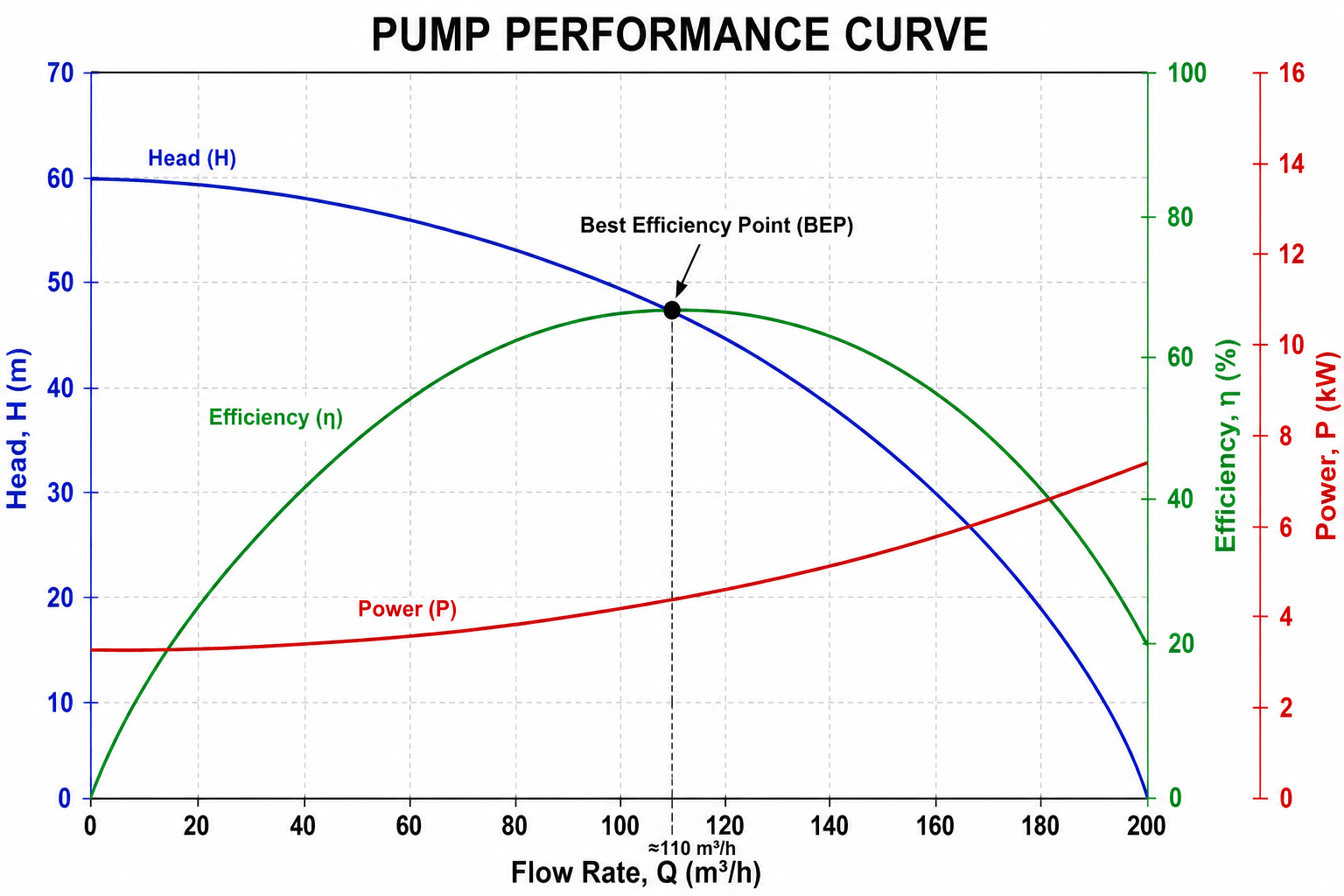
A pump may be capable of producing high pressure at low flow. However, when the required flow increases, the available pressure may decrease. For this reason, pump selection should always consider the required flow and required pressure at the same operating point.
What Happens When Pressure Increases?
When system resistance increases, the pump usually needs to develop more pressure to maintain flow.
For example, imagine water flowing through a pipeline. If a valve is partially closed, the resistance in the system increases. As a result, the operating point of the pump changes. Similarly, a longer pipeline or smaller pipe diameter can create additional resistance. Therefore, simply choosing a pump based on its maximum flow rate can lead to poor performance if the system also requires high pressure.
What Happens When Flow Increases?
When you require more flow, the pump may operate at a different point on its performance curve. In many centrifugal pump applications, higher flow is associated with lower discharge pressure. However, the exact relationship depends on the pump design and system conditions. Positive displacement pumps work differently. They are generally designed to deliver a relatively fixed volume per cycle, while pressure is mainly determined by the resistance in the system. That is why understanding the type of pump is also important when comparing flow and pressure.
Centrifugal Pump Flow vs Pressure
Centrifugal pumps are widely used for applications that require continuous fluid movement.
They are commonly used for:
- Water transfer
- Cooling systems
- Irrigation
- Pipeline operations
- Industrial circulation
- General fluid handling
For centrifugal pumps, flow and pressure are closely linked to the pump’s performance curve. Generally, as flow increases, the available discharge pressure or head decreases. Therefore, engineers should check the pump curve to determine the expected flow at the required pressure.
Positive Displacement Pump Flow vs Pressure
Positive displacement pumps operate differently from centrifugal pumps. These pumps move a defined volume of fluid during each operating cycle. Examples include:
- Plunger pumps
- Piston pumps
- Diaphragm pumps
- Gear pumps
- Screw pumps
Positive displacement pumps are often suitable for applications that require high pressure and controlled flow. For example, plunger pumps are commonly used in:
- Hydrostatic testing
- High-pressure cleaning
- Pressure testing
- Water blasting
- Pipeline maintenance
- Industrial process applications
However, a positive displacement pump should always be operated with appropriate pressure relief and safety systems.
Flow vs Pressure: Which One Is More Important?
There is no single answer. The importance of flow or pressure depends on the application.
Choose Based on Flow When:
You need to move a large volume of fluid quickly.
For example:
- Filling large tanks
- Pipeline flushing
- Water transfer
- Cooling applications
- Circulation systems
In these cases, a high flow rate may be the main requirement.
Choose Based on Pressure When:
The application requires the fluid to overcome high resistance or perform a pressure-related task.
For example:
- Hydrostatic testing
- High-pressure cleaning
- Water jetting
- Pressure testing
- Pipeline pressure applications
In these situations, pressure may be the more important specification.
When You Need Both
Many industrial applications require both adequate flow and pressure. For example, a pipeline cleaning system may need enough pressure to remove debris while also requiring sufficient flow to carry the debris through the pipeline. Therefore, the best pump is usually the one that provides the required flow at the required pressure, rather than the pump with the highest maximum rating.
Why Maximum Flow and Maximum Pressure Can Be Misleading
Pump specifications often show maximum flow and maximum pressure. However, these two maximum values may not be available at the same operating point. For example, a pump might be advertised as:
500 m³/hr maximum flow and 40 bar maximum pressure.
This does not necessarily mean the pump can deliver 500 m³/hr at 40 bar. Instead, these values may represent different operating conditions. Therefore, always check the pump performance curve or technical data sheet to determine the actual flow available at your required pressure.
How to Select the Right Pump
When selecting a pump, start by identifying the actual requirements of your system.
1. Determine the Required Flow
First, calculate how much liquid needs to be moved. For example, determine whether the application needs 50 m³/hr, 100 m³/hr, or 500 m³/hr.
2. Determine the Required Pressure
Next, determine the pressure required at the pump discharge. Consider pipeline resistance, elevation, valves, fittings, nozzles, and other equipment.
3. Consider the Fluid
The fluid being pumped also affects pump selection.
Consider factors such as:
- Water or other liquid
- Temperature
- Viscosity
- Density
- Chemical properties
- Presence of solids
4. Check the Pump Curve
Once you know your flow and pressure requirements, check the manufacturer’s pump curve. The ideal operating point should meet your required flow and pressure without pushing the pump beyond its recommended operating range.
5. Consider the Power Requirement
Finally, make sure the available motor or engine has enough power to operate the pump at the required duty point. This is especially important for high-pressure and high-flow industrial pumping systems.
Common Mistakes When Comparing Pump Flow and Pressure
A common mistake is choosing a pump based only on its maximum flow. Another mistake is selecting the pump with the highest pressure rating without checking whether it can provide the required flow. Additionally, some users compare pumps from different manufacturers using only one specification. However, pump performance depends on the complete operating point.
Therefore, always compare:
- Flow
- Pressure or head
- Power
- Fluid type
- Pump type
- Operating speed
- Efficiency
- Application requirements
This provides a much better basis for selecting the correct pump.
Simple Example of Flow vs Pressure
Consider a high-pressure cleaning application. You may have two pumps:
Pump A:
200 m³/hr at 10 bar
Pump B:
50 m³/hr at 100 bar
Pump A moves much more water. However, Pump B produces significantly higher pressure. If the application requires a strong high-pressure water jet, Pump B may be more suitable. On the other hand, if the main goal is to move a large volume of water quickly, Pump A may be the better choice. Therefore, the correct pump depends on the actual job requirements.
Final Thoughts
Understanding pump flow vs pressure makes pump selection much easier. Flow describes how much liquid the pump can move, while pressure describes the force available to move that liquid through the system.
More importantly, these two specifications must be considered together. A pump with high flow is not necessarily a high-pressure pump. Likewise, a high-pressure pump may not provide the large flow rate required for fluid transfer.
Therefore, before selecting a pump, identify the required flow, pressure, fluid type, operating conditions, and application. Then, use the manufacturer’s performance data to find the pump that can meet those requirements at the correct operating point.
By understanding the relationship between flow and pressure, you can choose a pump more confidently, improve system performance, and avoid selecting equipment that does not match the application.